
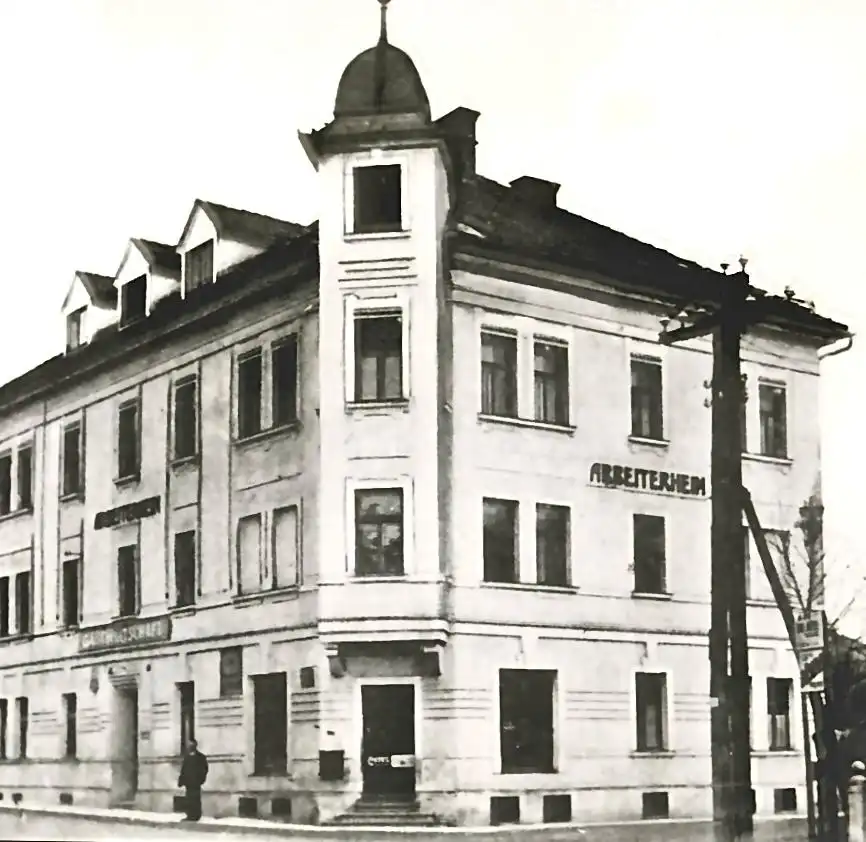
Former Workers’ Hostel, Klagenfurter Straße
In Austria, a worker’s hostel (Arbeiterheim), holds both historical and social significance, particularly in the context of labour movements, industrialisation, and migration.
Historical Significance
In the 19th and early 20th centuries, Austria underwent industrialisation. Many workers – especially from rural areas or other parts of the Austro-Hungarian Empire – moved to cities such as Vienna, Linz, and Graz to work in factories.
These workers often had no stable housing, and workers’ homes (Arbeiterheime) were created to provide affordable, communal living.
Many of these hostels were linked to social democratic or trade union efforts. They were not merely shelters; they were often centres of political education, solidarity, and mutual aid.
Social Role
These hostels offered cheap accommodation with basic facilities, including shared rooms and communal kitchens.
They functioned as entry points for migrant workers, especially during the post-WWII economic boom, when Austria relied on guest workers (Gastarbeiter) from countries like Turkey and Yugoslavia.
The hostels helped to integrate newcomers into Austrian labour markets.
Cultural Impact
The Arbeiterheim is also symbolic of the working-class experience in Austria.
It appears in literature, film, and historical accounts as a place of hardship, camaraderie, and resistance.
Historical Photograph
Image Source: Archive of the Municipal Authority of St. Veit an der Glan
Workers’ Hostel
Photo Impression (c. 1925)
This building was bombed and damaged during WWII. After removal of the damaged remains, a new building was erected.